Showing posts with label news. Show all posts

Monday, October 26, 2020

New world news from Time: Protests Against an Abortion Ban Continue for a Fifth Day in Poland


WARSAW, Poland — Women’s rights activists and many thousands of supporters held a fifth day of protests across Poland on Monday, defying pandemic restrictions to express their fury at a top court decision that tightens the predominantly Catholic nation’s already strict abortion law.

In Warsaw, mostly young demonstrators — women and men — with drums, horns and firecrackers blocked rush-hour traffic for hours at a number of major roundabouts. Some of them took off their shirts and stood topless on top of cars. Many held banners with an obscenity calling on the right-wing government to step down.

A group of far-right supporters held a counter-protest in front of a church and police in riot gear kept the two groups apart, using pepper spray at one point. Some of the people protesting the court ruling were detained and others sat down in the street to stop the police van taking away the detainees.

A protesting woman was taken to hospital with slight injuries after she and another woman were hit by a car. The other woman was not injured.

Organizers said people joined their protests in more than 150 cities in Poland, including Poznan, Lodz and Katowice. It was one of the biggest protests against the government in recent years.

In Krakow protesters chanted “This is War!” — a slogan that demonstrators have repeated often in recent days. They also shouted obscenities against the country’s traditionally respected Roman Catholic bishops.

Krakow archbishop Marek Jedraszewski said the protests were marked by “aggression unknown so far in Poland, when the sanctity of churches, of sacred places is being violated.”

Protesters defied a nationwide ban on gatherings intended to halt a spike in new coronavirus infections.

They have taken to the streets each day since the Constitutional Tribunal ruled Thursday that it was unconstitutional to terminate a pregnancy due to fetal congenital defects. The ruling effectively bans almost all abortions in the country.

The ruling has not taken effect yet, because it has not been officially published, which is a requirement of a law’s validity.

The head of a doctors’ group, Dr. Andrzej Matyja, speaking on Radio Zet, criticized the ruling’s timing during the pandemic, saying it amounted to an “irresponsible provoking of people to rallies” where social distancing cannot be maintained.

Poland’s conservative leaders have also come under criticism from professors at Krakow’s reputed Jagiellonian University who said that announcing such a ruling during a pandemic was an “extreme proof of a lack of responsibility for people’s lives.”

In a letter to Prime Minister Mateusz Morawiecki and to President Andrzej Duda, who is infected with the coronavirus, the professors appealed for a “way out of the situation … to be urgently found.”

Many gynecologists have also criticized the ruling. Dr. Maciej Jedrzejko said the ban will result in a rise in the number of dangerous, illegal abortions, arguing that sex education and access to contraceptives are the best ways to limit abortions.

The ruling by the government-controlled court overturned a provision of the 1993 law forged by the country’s political authorities and church leaders after the fall of communism. That law permitted abortion in only limited cases, becoming one of Europe’s strictest abortion regulations.

When the ruling takes effect, the only permitted abortions will be if a pregnancy threatens the woman’s health or is the result of rape or incest.

Among those who support the ruling is European Parliament lawmaker for the conservative ruling party, Patryk Jaki, who is the father of a child with Down syndrome. He warned on Twitter that abortions can also eliminate healthy children “because you rarely are 100% sure.”

Jaki also argued that abortions contribute to the nation’s low birthrate and said that they could be a “threat to Poland’s state.”

Health Ministry figures show that 1,110 legal abortions were carried out in Poland in 2019, mostly because of fetal defects. The non-governmental Federation For Women and Family Planning estimates that Polish women undergo some 100,000 to 150,000 abortions a year, some illegally in Poland and others abroad.

Women’s Strike, the key organizers of the past day’s protests, says that forcing women to carry through pregnancies involving fetuses with severe defects will result in unnecessary physical and mental suffering for the women.

Group leader Marta Lempart said there will also be a nation-wide strike Wednesday and a protest march Friday in Warsaw, the seat of the government, the constitutional court and the right-wing ruling Law and Justice party behind the court’s decision.

Thursday, October 15, 2020

New world news from Time: The Fatal Gang Rape of a Young Woman Is Forcing a Reckoning in India Over the Caste System


On Sept. 29, a 19 year-old woman died of injuries after she was allegedly gang raped by a group of men in a field in Hathras district, in the north Indian state of Uttar Pradesh. She was a Dalit, member of a community at the bottom of India’s rigid caste hierarchy, while the four alleged perpetrators, who have been arrested and charged with murder and rape, are members of a dominant upper caste.

The woman had spent two weeks fighting for her life in a Delhi hospital after the alleged gang rape on Sept.14, which left her with severe damage to her spinal cord. (The woman has not been named in the Indian press due to a law that prohibits identifying the victims of sexual violence.)

The night of her death, police returned to the family’s village with her body. But instead of handing her over to her mourning family, the family has said the police insisted she be cremated there and then. When the family refused, saying they wanted time to say goodbye, police locked them in their home and took her to a field where they burned her body using gasoline, the family said.

Read More: Nothing Has Changed.’ 7 Years After a Gang Rape That Shocked a Nation, Brutal Attacks Against Women Continue

In 2014, Prime Minister Narendra Modi came to power with a pledge of “zero tolerance” toward violence against women, after the gang rape and murder of a 23 year-old woman in Delhi in 2012 shocked the nation. But India is still the most dangerous country in the world to be a woman, according to a 2018 survey of experts by the Thomson Reuters Foundation, citing sexual violence, cultural traditions and human trafficking as the main reasons for the ranking. In 2019, there were an average of 87 reported rape cases per day, according to official statistics.

The problem is even more pronounced for Dalits. More than 3,500 were raped in India in 2019, an increase of 18.6% compared to 2018. But the real number is likely far higher, says Kiruba Munusamy, a Dalit lawyer who works on caste discrimination and gender violence cases. “The upper caste groups use sexual violence as a tool, to reinforce their caste hegemony, and their caste supremacy,” Munusamy says. “And for that reason, many families are afraid to go even to the police station.”

The Hathras case sparked protests across the country, including in Delhi.

Dalits

Once known by the outdated term “untouchables,” Dalit is a broad term for the communities at the very bottom of the Hindu caste system. There are 200 million Dalits in India, and although caste discrimination was legally outlawed in India’s 1950 constitution, systemic discrimination against them remains widespread. The Hathras victim was reportedly from the Valmiki community, a caste which is considered “lowest in hierarchy” even among Dalits in Uttar Pradesh, according to Suryakant Waghmore, author of Civility Against Caste.

Many Dalit activists see the Hathras case as a particularly brutal example of how Dalit women are not only regular victims of sexual violence in India, and an example of how the state is often complicit, making it difficult for victims to get justice.

Protests After Death Of Hathras Rape Victim In Guwhati
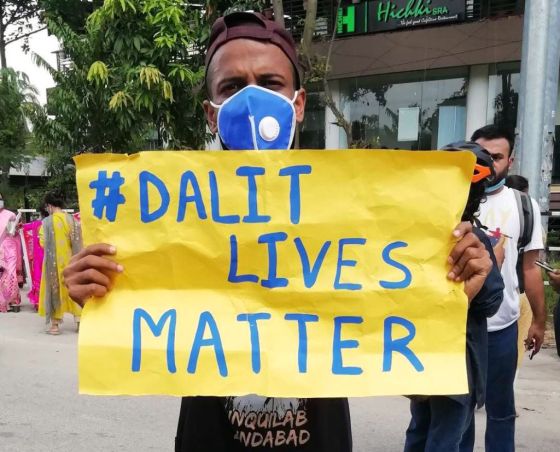
David Talukdar—NurPhoto/Getty ImagesA protester holds a sign reading “Dalit Lives Matter” at a protest against the Hathras gang rape, in Guwahati, Assam, India on October 3, 2020.

The victim first told police she was raped on Sept. 14, shortly after the attack, according to videos taken shortly after at the scene of the crime, seen by the BBC. But her allegations of rape were only recorded by police eight days later on Sept. 22, after she made what’s known in India as a “dying declaration,” identifying the four men she said had assaulted her. After her death on Sept. 29 police cited a forensic report, later discredited by doctors, that said the girl was not raped. A PR firm working for the Uttar Pradesh state government pushed the line to the media, calling the case a “conspiracy to push the state into caste turmoil,” according to Indian media reports.

The behavior of the police and state government, activists say, is a clear example of systemic discrimination. “People don’t really accept when you say that Dalits are discriminated on a day to day basis because of caste,” says Munusamy. “But the Hathras case is something tangible.”

India’s rape problem

India’s rape problem gained international attention in 2012 when a woman was violently gang-raped and murdered on a bus in Delhi. The victim, named “Nirbhaya” (fearless) by the Indian media due to laws against identifying rape victims, died in a hospital in Singapore two weeks later, after being flown there by the Indian government.

Dalit rights activists say that while both cases were terrible crimes, the difference in the state’s treatment of the two victims reveals something about caste. “The Hathras offense was very similar to Nirbhaya,” says Munusamy. “In the case of Nirbhaya, the state tried its best to make her survive. But in the case of Hathras, she was admitted to a local hospital. Even after she died, she was not given the respect of her body.” (The Hathras victim was treated in Aligarh hospital in Uttar Pradesh; she was transferred to the same hospital Nirbhaya was treated at in Delhi one day before she died.)

In the aftermath of the Nirbhaya case, many called for sentences for rapists to be made more stringent. Four of the six accused in that case were executed by hanging in March 2020.

But activists say stricter punishments have failed to address the root cause of the crime. “All too often lawmakers in India hold up the death penalty as a symbol of their resolve to tackle crime. But what is actually needed are effective, long-term solutions like prevention and protection mechanisms to reduce gender-based violence, improving investigations, prosecutions and support for victims’ families,” said Avinash Kumar, the executive director of Amnesty India, in a statement in March. (In September, Amnesty India was forced, by legal pressure from the Indian government, to halt all its human rights operations. It had released many reports criticizing the government for human rights violations.)

The aftermath of the Hathras victim’s death

Tanushree Pandey, a journalist from India Today, was at Hathras when police returned to the village with the victim’s body. Her videos from the scene, posted in real time to Twitter as police cremated the victim without her family present, brought wider attention to a case that activists say would likely otherwise have gone unrecognized.

The following day, Uttar Pradesh chief minister Yogi Adityanath said he had spoken with Prime Minister Narendra Modi about the case. In a Sept. 30 tweet, Adityanath reported that Modi had “said that strict action should be taken against the culprits.” Meanwhile, however, police officers (who report to Adityanath’s office) had barricaded entry to the village where the rape took place.

Samajwadi Party Workers Protest In Hathras Demanding Justice For Gangrape Victim
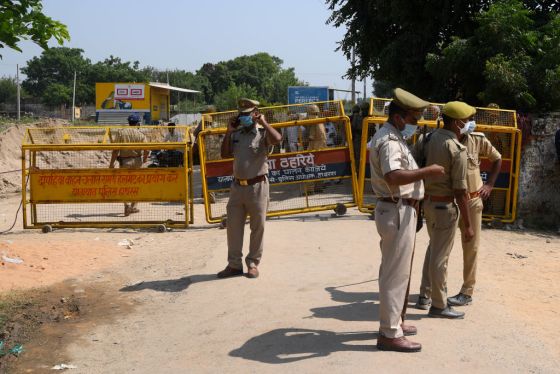
Amal KS—Hindustan Times/Getty ImagesPolice barricading on the way to the home of the victim in the Hathras gang rape case on October 1, 2020 in Hathras, India.

The next day, when the leaders of the main opposition party, Rahul and Priyanka Gandhi, tried to travel to the village to meet with the family, video showed police pushing Rahul to the ground. The pair were briefly arrested. The same day, Uttar Pradesh police claimed that according to a forensic report, no rape had taken place and that the victim had died from being strangled. The state government pushed this line to media through a PR agency. But the forensic examination was only conducted eight days after the assault—too late, according to guidelines, for an accurate conclusion of rape to be drawn.

On Oct. 2, police allegedly assaulted the victim’s uncle and intimidated the family in an attempt to stop them speaking to the press, according to the victim’s cousin. Amid outcry, the superintendent of police in Hathras was suspended for “negligence and lax supervision” by the Uttar Pradesh government, along with four others.

Despite the suspensions, a lawyer for the victim’s family said the intimidation has continued as national attention on the case has grown. “The family is receiving open threats, their phones are being tapped by the police,” the lawyer said, according to an Oct. 9 Indian Express report. “Is this the way to treat a victim’s family? They feel unsafe, their neighbours are rude to them. They don’t want compensation, they want justice.”

Caste in Uttar Pradesh

Activists say that, as with institutional racism in U.S. police forces, the Hathras case indicates the problem with India’s police is not caused by a few bad apples but because of a systemic problem with caste.

Uttar Pradesh is India’s most populous state with more than 200 million people. Thakurs are a dominant caste there, making up just 8% of the population but owning more than 50% of the land, according to the Print.

The four alleged rapists are Thakurs. Thakurs have a large presence in the police and state government, including the state’s chief minister, Adityanath, a senior figure in India’s ruling Hindu nationalist Bharatiya Janata Party (BJP).

“Thakur supremacy, landowning, and the power Thakurs play in electoral politics are very significant. The police officials, magistrate, are all from the Thakur community. Grave ignorance of law comes from the fact they are all Thakurs and they want to maintain their supremacy. It is something embedded in the culture of Uttar Pradesh,” says Munusamy. “Most Dalits in rural areas work on the agricultural lands of upper caste groups. So if they lodge a complaint they have to risk their very livelihoods and safety.”

Activists say that the power dynamics of Uttar Pradesh are key to understanding the context of the state response to the Hathras case. “The fact that the perpetrators of this brutal and horrendous act belong to the same caste as Adityanath’s, gives a clue as to why his government failed to protect the girl,” said Ahsan Khan, president of the Indian American Muslim Council, in an Oct. 4 statement.

What does the Hathras case mean for Dalit rights?

The Hathras case is one of the most prominent examples of the rape of a Dalit woman receiving sustained national attention in India. “For us, this is very important because it is a milestone in the Dalit women’s movement. It has brought us into center stage. And it has created spaces for the issues of Dalit women and girls, which have most of the time been marginalized, not only by the feminist women’s rights movement, but also by by the Dalit movement, which is quite male dominated,” says Manjula Pradeep, a Dalit human rights activist and former executive director of the Navsarjan Trust, one of the largest Dalit rights organizations in India.

But activists say that there is a long way to go before they achieve lasting cultural change. “I think the mind of the people has to change,” Pradeep says. “India is a very caste-based society and it’s also a patriarchal society. People’s minds are very narrow, and they are into this idea of purity and pollution, where they don’t see others as equals. That mindset has to be changed, and that is the biggest challenge for us. Because people don’t want to change, because there’s power.”

Wednesday, October 14, 2020

New world news from Time: Thai Leader Declares ‘Severe’ State of Emergency in Bangkok as Anti-Government Protests Continue


BANGKOK — Thai police early Thursday dispersed a group of pro-democracy protesters who camped out overnight outside the office of the prime minister to demand his resignation, leading him to implement a “severe” state of emergency in the capital area.

An Associated Press journalist saw riot police advance from multiple locations to force out a few hundred protesters who remained outside Government House, the seat of Prime Minister Prayuth Chan-ocha. Protesters were seen taken away into police trucks.

The police operation came after Prayuth declared a severe state of emergency in the Bangkok area to allow authorities to move against the protests.

Thailand is technically still under a state of emergency as part of coronavirus restrictions.

Before the police dispersal, a large number of protesters had already left the area after one of the their leaders announced the end of the rally at Government House though a few hundred stayed on. It was also announced that the rally would move to a different location in the capital Thursday afternoon.

The latest rally started on Wednesday with thousands of protesters marching from Bangkok’s Democracy Monument to Government House. It was the third major gathering by activists who want to keep up the momentum in their campaign for democratic change.

The protesters have drawn attention because of their demands for reforms to Thailand’s constitutional monarchy, which they claim does not properly operate in a democratic framework.

That demand has caused a huge controversy because the royal institution has long been considered sacrosanct and a pillar of Thai identity. It is also protected by a lese majeste law that mandates three to 15 years in prison for defaming the monarchy.

Conservative royalist Thais accuse them of seeking to end the monarchy, an allegation they deny. Before leaving Democracy Monument, several small clashes broke out between protesters and their opponents, who traded punches and threw plastic bottles as police tried to keep them apart.

The situation was complicated by King Maha Vajiralongkorn’s scheduled drive past the protest venue to attend a royal ceremony. The protesters said they would make way but there was a possibility that they could at a minimum show public disrespect for the crown. Several cars normally used by the royal family were seen on nearby streets but their occupants could not be confirmed. Unverified video and photos on social media showed what was purported to be protesters gesturing and shouting close to the vehicles, which would be unprecedented for Thailand, where the royal family has traditionally been revered.

The king made a similar drive past the area on Tuesday after police cleared tents set up near the monument and arrested 21 people on minor charges.

The protest movement was launched in March by university students but quickly put on hold as Thailand was gripped by surges in coronavirus cases. It came back in July, when the threat from the virus eased, and since then has again been spearheaded by students and publicized on social media.

The movement’s original core demands were new elections, changes in the constitution to make it more democratic, and an end to intimidation of activists.

The protesters charge that Prayuth, who as army commander led a 2014 coup that toppled an elected government, was returned to power unfairly in last year’s general election because laws had been changed to favor a pro-military party. Protesters say a constitution promulgated under military rule is undemocratic.

___

Associated Press writer Busaba Sivasomboon contributed to this report.

Tuesday, September 29, 2020

New world news from Time: Trump vs. Biden: Facing Off on Taming a ‘Rising China’


As President, Donald Trump has cast China as a global villain: a malevolent actor that all but launched a worldwide pandemic on an unsuspecting world, robbed Americans of their jobs and stole U.S. business secrets. He has made the Chinese Communist Party a catch-all enemy that pulls puppet-like strings to make international organizations like the World Health Organization work at cross-purposes with Washington, all charges Beijing vigorously denies.

At the same time, Trump has presented himself to the world—and to U.S. voters—as the only person capable of pummeling Beijing into submission, chiefly through a landmark trade deal. Democrats, the President and his allies say, are the willing patsies who bow to Beijing, as when former Vice President-turned-Democratic presidential candidate Joe Biden sought closer ties to the growing superpower in his multiple visits there. “A rising China is a positive, positive development, not only for China but for America and the world writ large,” Biden said in 2011 after returning to the U.S. from one such trip.

It’s a black-and-white narrative that will be argued on stage Tuesday night during the first Presidential debate in Cleveland, Ohio, with each man’s record and the COVID-19 pandemic on the debate docket. China will loom large for its role as Trump’s designated fall guy for the virus that has killed more than 200,000 Americans, for its economy, which is thriving despite the pandemic, and for its military, which could surpass America’s in size and strength by 2049.

Biden heads for the debate stage buoyed by an August Fox News poll that shows more Americans trust him over Trump to handle China. He is sure to point out Trump’s swings between painting China as an existential threat to the U.S. and effusive praise for Chinese leader Xi Jinping.

But many Trump supporters, if not most Americans, have become accustomed to Trump’s praise of strongmen in public, which in this case has given way to a barrage of insults, slamming Xi for letting the “Wuhan virus” spread. And Trump’s arguments that the Obama Administration was fooled by China could be persuasive on live television, says Michael Green, an Asia specialist from the Center for Strategic and International Studies. “The Trump Administration’s line,” says Green, a former Bush official who has backed Biden, “is that everybody was duped by China.” Green says that is “ridiculous and wrong…but it’s a pretty easy line to use in a debate.”

It will be tricky for Biden to counter these charges in clear terms to the American people. During his early years as Vice President, Washington and key allies like the U.K. were still hopeful of working with China, guardedly optimistic that Chinese Communist Party leaders could be carrot-pulled into more free-market, human-rights and democracy-oriented behavior.

The last year has seen China double down in a different direction. Its crackdown on Hong Kong demonstrators culminated in enacting a National Security Law on the region, decades ahead of the city’s agreed return to Chinese rule, and it has continued its crackdown on Muslim Uighurs, with hundreds of thousands reportedly sent to re-education camps.

The Trump Administration has accused Chinese leaders of being slow to tell the world how easily COVID-19 was spreading from person to person, and slow to admit a WHO team trying to investigate the outbreak. The Administration criticized China for releasing a DNA map of the virus without also sharing actual physical samples, which could help determine whether it jumped from animals or originated in a Chinese weapons lab, a popular but unsubstantiated theory among some in the GOP that is ridiculed by Chinese officials.

The Trump Administration has pursued a go-it-alone policy of using economic pain to bring Beijing to the negotiating table, aiming to check unfair trading practices and China’s aggressive militarization in the South China Sea. The Administration has slapped hundreds of billions of tariffs on Chinese goods, and imposed sanctions against alleged Chinese hackers accused of stealing U.S. intellectual property. The U.S. has also sanctioned Chinese officials who have cracked down on Hong Kong and the country’s Muslim Uighur minority.

The tough talk led to the January signing of the first phase of a trade deal, which keeps U.S. tariffs on Chinese goods largely intact, with the threat of more if China doesn’t follow through, and requires Beijing to buy upwards of $200 million in U.S. goods and services over the next two years. As of August, China has only bought $56.1 billion in U.S. goods, according to the Peterson Institute for International Economics, and with Trump skewering Beijing verbally at every opportunity, doesn’t appear to be working to step up spending.

Meanwhile, China’s global exports rose this summer, mainly because of its dominance of personal protective equipment manufacturing and work-from-home technology, according to the Council on Foreign Relations, while the U.S. trade deficit with China has grown. The U.S.-China trade war had already cost 300,000 jobs since it started in early 2018, according to Moody Analytics, even before the coronavirus wreaked havoc on the U.S. job market.

Biden’s own approach to China, as outlined in his public comments so far, sounds like a Trump-lite trade policy with a side of wishful thinking that Beijing can still be coaxed back to better behavior by a concerted scolding by Washington and its allies. He told the Council on Foreign Relations he would double down on Trump’s sanctions over the Hong Kong security law and its detention of up to a million minority Uighurs, but he told NPR that he would lift tariffs on Chinese imports and work through international trade bodies like the WTO to bring Beijing to heel.

Biden claims a key tool to counter China would be to super-charge those measures in cooperation with allies, in part by renegotiating the Trump-abandoned Trans-Pacific Partnership (TPP) trade deal, an acronym that by itself can cause eyes to glaze, to band Pacific economies against Beijing. As Biden wrote in Foreign Affairs, “The most effective way to meet that challenge is to build a united front of U.S. allies and partners to confront China’s abusive behaviors and human rights violations, even as we seek to cooperate with Beijing on issues where our interests converge.”

Explaining that on stage on Tuesday would be a wonky turn likely lost on any popular audience, who may not remember that it was combined allied economic action against Iran that brought it to the negotiating table for the Iran nuclear deal, an argument that would draw scorn from most Republicans.

Trump, for his part, will likely argue that if a tougher tack had been taken sooner, it might have clipped Beijing’s wings—though some current and former U.S. military and intelligence officers will tell you China was always heading this way, citing hawkish books like The Hundred-Year Marathon, which relies on Chinese documents and defectors to claim, controversially, that China intends to replace the U.S. as a global superpower by 2049.

Trump has already previewed a debate attack to come on Biden’s son Hunter, who Trump has claimed made more than a billion dollars in an investment deal with the Bank of China, less than two weeks after flying there on his father’s plane in 2013, a charge that multiple fact-checks have found false. Hunter Biden’s spokesperson George Mesires tells TIME that he has “never made any money” from BHR Partners, the company he founded that struck the deal, “either from his former role as a director, or on account of his equity investment, which he is actively seeking to divest.”

Then and Now

When Biden served as Vice President, he helped launch Obama’s 2009 “U.S.-China Strategic and Economic Dialogue.” At the time, it seemed that Washington and Beijing could work together toward common good in the service of mutual interests. Those early efforts arguably produced tangible results, as when both countries signed up to the Paris Climate Agreement in 2016, together representing 40% of the world’s greenhouse gas emissions. “We are moving the world significantly towards the goal we have set,” Obama said of the nations’ cooperation. China also “tightened its controls on weapons sold to Iran” in response to U.S. pressure, according to a Brookings Institution review, and the countries worked together to keep North Korea in check.

“There was very broad bipartisan support for a strategy towards China… that mixed engagement with China, and counterbalancing China by keeping our defenses strong, pushing on human rights, and especially working with allies, like Japan, and Australia,” says Green, the former Bush NSC official.

The mood soured, however, by the second Obama/Biden term, with the Obama Administration decrying thousands of cyberattacks a day on the U.S. government by Chinese military hackers, and later arresting a Chinese national for the theft of millions of government employees’ personal records from the Office of Personnel Management by a secretive Chinese military hacking unit, leading to a bilateral anti-hacking pact that the Trump Administration later accused the Chinese of violating.

Obama and Biden also negotiated the TPP—which Trump swiftly pulled out of after his inauguration in 2017—to gather together 12 regional Pacific economies, representing 40% of the world’s trade, into a single trading market to offset China’s economic bullying. And Obama’s military challenged China’s construction of an artificial island and military base in the South China Sea with its own “presence patrols” of U.S. Naval vessels steaming through sea channels in international waters that China was trying to claim for its own.

All of the Obama Administration’s efforts were eventually swallowed up and erased, like the wakes of those U.S. Naval ships, in part by Trump’s TPP departure, but mostly by the steady waves of a strategically planned and clinically executed Chinese campaign to widen its economic influence, build its military might, and become a diplomatic superpower that cannot be ignored on any major international issue.

The U.S. public hasn’t paid much heed to China’s long-game, but the COVID-19 crisis has caused more Americans to see China negatively, according to a Pew Research Service poll released in July. It’s against that backdrop that Biden will have to explain to information-overwhelmed American viewers why he once entertained the notion that China’s Communist Party could be reasoned with, and how his policies would produce a different result than the steadily increasing cold war between Beijing and Washington.

China-focused political economist Derek Scissors, of the right-leaning American Enterprise Institute, believes both candidates are weak on China. He says the first phase of the President’s trade deal is a “failure,” with U.S. exports to China “far behind schedule,” U.S. portfolio investment in China soaring, Beijing’s hack-and-grab theft of U.S. intellectual property continuing, and Trump’s sanctions having little effect on Chinese tech companies’ predatory behavior.

On the other hand, Biden’s China record is one of “wishful thinking,” Scissors says, mostly focused on global climate change initiatives. “The Obama Administration was paralyzed by hope for meaningful Chinese cooperation, instead getting an increasingly nasty dictatorship,” he says. “Biden’s move away from that approach is unconvincing so far.”

Retired Amb. Joseph DeTrani, former CIA director of East Asia Operations, says both candidates behaved appropriately for the China they faced at the time. In Biden’s engagement with China as a Senator during the 1980s and 1990s “bilateral relations were solid,” he says, so cooperative moves like championing Beijing’s entry into the World Trade Organization were appropriate. When tensions later rose, the Obama Administration announced its “pivot” to East Asia, concerned about China’s behavior in the South and East China Seas and its ambitious Belt and Road Initiative, which ostensibly aimed to improve China’s physical access to markets by building roads, bridges and ports globally, but instead often trapped countries in debt-ridden deals that forced them to forfeit ownership of the projects to the Chinese.

DeTrani says Trump can argue that he, rather than his predecessors, acted against Beijing’s predatory trade practices, including “a very unfavorable historical trade imbalance with China, something previous administrations ignored.” He points out that Trump’s position hardened when it became clear China hadn’t shared data on the pandemic “in a timely way,” and with its crackdown on Hong Kong, the proliferation of Uighur reeducation camps and other human rights abuses.

With China’s military growing, already outpacing the U.S. Navy, and its still-expanding economy keeping it on track to eclipse U.S. power in the next decade, according to the Australia-based Lowy Institute, the next U.S. president will be facing a formidable adversary that no recent American leader has managed to check.

Monday, September 28, 2020

New world news from Time: 1 Million People Have Died of COVID-19. It’s a Reminder That We Still Have So Much to Do


With an ever-climbing tally of COVID-19 infections, deaths, and calculations about how quickly the virus is spreading, the numbers can start to lose meaning. But one million is a resonant milestone.

According to the Johns Hopkins Coronavirus Resource Center, the world has now lost one million lives to the new coronavirus. It’s easy to draw analogies—one million people dying of COVID-19 would be the equivalent of just over the entire population of a country like Djibouti, or just under the populace of Cyprus. Perhaps more sobering would be to think of that number less as an entity and more in terms of the precious individual lives it represents. It’s a chance to remind ourselves that each of those deaths is a mother, a father, a grandmother, a grandfather, a friend, a loved one.

It’s also a warning to learn from these deaths so they haven’t occurred in vain. When the novel coronavirus burst into the world last winter, the best virus and public health experts were initially helpless to combat infections in a world where almost nobody had any immunity to fight it. As a result, the mortality rate, which hovered just under 3% around the world starting in late January, slowly began to creep upward, doubling in two months and hitting a peak of more than 7% at the end of April before inching downward again.

While every death from COVID-19 is one too many, public health experts see some hope in the fact that while new cases continue to pile up around the world, deaths are starting to slow. That declining case fatality curve was and continues to be fueled by everything we have learned about SARS-CoV-2 (the COVID-19 virus) and everything that we have put into practice to fight it. That includes using experimental therapies like the antiviral drug remdesivir, as well as existing anti-inflammatory medicines that reduce the inflammation that can compromise and damage the lungs and respiratory tissues in the most severely ill patients.

That falling case fatality is also due in part to wider adoption of prevention strategies such as frequent hand washing, mask wearing and social distancing. And to the fact that globally, we began testing more people so those who are infected can then self-isolate quickly.

Read more: The Lives Lost to Coronavirus

Still, another thing we have learned from the pandemic is that deaths often lag behind cases, sometimes by months. And the number of cases globally continues to increase, especially in new hot spots in South America and India, so the declining curve of the fatality rate hasn’t necessarily led to fewer overall deaths.

Understanding how the geography and nature of COVID-19 deaths have shifted in recent months will be critical to maintaining any progress we’ve made, as nations and as a species, in suppressing COVID-19. In the U.S., for example, deaths early in the pandemic were centered in densely populated metropolitan areas, where infections spread quickly and hospitals became overwhelmed with severely ill people needing intensive care and ventilators to breathe. The virus had the advantage, and exploited the fact that there wasn’t much that science or medicine could do to fight it.

Read more: COVID-19 Has Killed More Than 200,000 Americans. How Many More Lives Will Be Lost Before the U.S. Gets It Right?

The only strategy was to take ourselves out of the virus’s way. Lockdowns that prohibited gatherings, mandates for social distancing and requirements that people wear masks in public helped to slow transmission and gradually reduce mortality, as the most vulnerable were protected from infection. But nine months into the pandemic, deaths are beginning to rise in less populated parts of the country. Medium- and small-sized cities and rural areas accounted for around 30% of U.S. deaths at their peak in late April, but in September they have been responsible for about half of COVID-19 deaths in the country.

The reason for that, public health experts suspect, has to do with the false sense of security that less populated communities felt and the assumption that the virus wouldn’t find them. Less stringent requirements and enforcement of social distancing and basic hygiene practices like hand washing and mask-wearing could have provided SARS-CoV-2 the entrée it needed to find new chances to infect people as those opportunities in more populated regions began to dwindle. Furthermore, health resources in rural areas aren’t as well distributed as they are in metropolitan regions, which makes preparing for an infectious disease more challenging.

Globally, COVID-19 mortality also reflects the unequal distribution of health care around the world. While developed countries are able to rely on existing resources—including hospital systems equipped with the latest medical tools and well-trained nurses and doctors—those resources aren’t as robust in lower income countries where health care isn’t always a high national priority. That puts these countries at greater risk of higher fatality from COVID-19 as new infections climb. Without medical equipment and personnel to ramp up testing and isolate infected people, or to care for the sickest patients, deaths quickly follow new infections.

That tragic reality is being borne out in recent case fatality trends. While the U.S. continues to lead the world in overall COVID-19 cases and deaths, the burden of deaths is shifting to countries such as Brazil and Mexico; Brazil has just over half the number of deaths of the U.S. Deaths in India are also likely to continue inching upward before they start to decline, as survival there under lockdown conditions is nearly impossible for families that have no income to buy food and pay rent. The pressure to reopen and re-emerge into densely populated cities will provide more fertile ground for COVID-19 to spread—and to claim more lives—before better treatments and vaccines can start to suppress the virus’ relentless blaze of despair.

Monday, September 14, 2020

New world news from Time: U.S. Ambassador to China Terry Branstad Is Stepping Down


(BEIJING) — The U.S. ambassador to China will step down early next month, ending a three-year tenure marked by a trade war and increasingly bitter relations between the world’s two largest economies.

Terry Branstad, appointed by President Donald Trump in 2017, confirmed his decision in a phone call with Trump last week, the U.S. Embassy said in a statement Monday. It did not give a reason for his departure.

“I am proudest of our work in getting the phase one trade deal and delivering tangible results for our communities back home,” he was quoted as saying at an embassy staff meeting on Monday.

U.S. Secretary of State Mike Pompeo in an interview late Monday thanked Branstad for his service.

“Over the past years, he’s done yeoman’s work helping us deliver on something that’s a complete change from what any administration has done with respect to the Chinese Communist Party,” Pompeo told Fox News.

Word of Branstad’s departure had leaked out earlier in the day when Pompeo thanked Branstad on Twitter for his service.

“Ambassador Branstad has contributed to rebalancing U.S.-China relations so that it is results-oriented, reciprocal, and fair,” Pompeo wrote in a subsequent tweet.

Branstad became embroiled in a recent controversy when China’s official People’s Daily newspaper rejected an opinion column that he had written.

Pompeo tweeted last week that China’s ruling Communist Party refused to run Branstad’s op-ed while the Chinese ambassador to the United States “is free to publish in any U.S. media outlet.”

Chinese foreign ministry spokesperson Zhao Lijian responded that Branstad’s article was “full of loopholes, seriously inconsistent with facts and wantonly attacks and smears China.”

The U.S. Embassy had contacted the People’s Daily on Aug. 26 about the piece, asking that it be printed in full without any edits before Sept. 4, the People’s Daily said in a statement posted online.

Pompeo in the Fox News interview said the departure was not related to the op-ed and speculated the ambassador wanted to return to Iowa, his home state.

Branstad, 73, was governor of the major farming state for 22 years over two spans, from 1983 to 1999 and 2011 to 2017.

Early in his first gubernatorial term, he met Xi Jinping, now China’s leader, when the then county-level Communist Party official visited Iowa on a 1985 trade trip.

Trump appointed him ambassador after a vacancy of several months, during which the embassy’s No. 2 official, David Rank, resigned after criticizing the Trump administration’s withdrawal from the Paris climate accord.

Soon after arriving in Beijing in June 2017, Branstad welcomed American beef back to the Chinese market after a 14-year ban, saying “I know it is a key priority of the president to reduce the trade deficit, and this is one of the ways we can do it.”

But trade relations quickly soured, as the U.S. imposed tariffs on Chinese products and China retaliated in kind. Other disputes followed over technology, human rights and the response to the coronavirus pandemic.

Branstad joined U.S. Trade Representative Robert Lighthizer and U.S. Treasury Secretary Steven Mnuchin at trade talks with Chinese counterparts in Beijing in May 2019.

The phase one deal reached the following January represented a truce but did not address the more fundamental complaints of the American side.

The U.S. Embassy statement also noted Branstad’s role in the effort to reduce the flow of fentanyl from China to the United States, including a 2018 pact in which China agreed to list the opioid as a controlled substance.

Branstad also made a rare visit to Tibet in May 2019, where he expressed concerns about what the U.S. called Chinese government interference in the freedom of Tibetan Buddhists to organize and practice their religion.

“He encouraged the Chinese government to engage in substantive dialogue with the Dalai Lama or his representatives, without preconditions, to seek a settlement that resolves differences,” an embassy statement at the time said.

Sunday, September 13, 2020

New world news from Time: Belarus Protests Enter Their Sixth Week With Continued Demands for President Lukashenko’s Resignation


KYIV, Ukraine — More than 100,000 demonstrators calling for the authoritarian president of Belarus to resign marched through the capital of Minsk on Sunday as the daily protests that have gripped the nation entered their sixth week.

Many in the crowd, which the human rights group Viasna estimated as numbering more than 150,000, carried placards critical of Russia, reflecting concerns about President Alexander Lukashenko’s planned meeting on Monday with Russian President Vladimir Putin.

It would be their first face-to-face contact since the unrest broke out in Belarus after the Aug. 9 presidential election that officials say gave Lukashenko a sixth term with 80% support. Protesters and some poll workers say the results were rigged.

Putin has said he stands ready to send Russian police into Belarus if the protests turn violent, stoking fears that Moscow could use the political dissent as an excuse to annex its neighbor like it did in Crimea in 2014. The countries have a union agreement envisaging close political, economic and military ties, although Lukashenko has repeatedly expressed concerns that Putin wants Russia to absorb Belarus entirely.

Some observers believe Lukashenko is going into the meeting in a weak position, and that Putin may capitalize on this to try to ease him out of power.

“Lukashenko has not been able to show Putin that he is in control of the situation and has put out the flame of protest, and this may push the Kremlin to seek an alternative scenario and candidate,” independent political analyst Valery Karbalevich told The Associated Press.

Lukashenko has ruled the Eastern European nation of 9.5 million people with an iron fist since 1994, harshly repressing the opposition and the media. But the protesters’ determination appears strong this time, despite daily detentions and reports of police beatings and abuse.

The Interior Ministry said more than 400 people were detained Sunday in Minsk. The ministry also reported that demonstrations took place in 16 other cities, including Brest, where police used water cannon against a crowd of several thousand.

“The source of power in Belarus is the people, not Lukashenko and the Kremlin,” read placards carried by some marchers in Minsk. “Tell me who your friends are and I will say who you are,” read another that bore photos of Lukashenko and Putin.

Police on Sunday set up rows of barbed wire and prisoner transport vehicles and deployed thousands of servicemen to block off the city center from demonstrators, but protesters came together outside the center and marched toward the presidential residence on the city’s outskirts.

Lukashenko, a former collective farm director, has rejected any concessions or mediation attempts and has repeatedly accused Belarus’ western neighbors of working to overthrow his government. In one show of aggressive defiance, he was seen striding with an automatic rifle across the grounds of his presidential residence.

—-

Jim Heintz in Moscow contributed to this report.

Tuesday, September 8, 2020

New world news from Time: Belarus Activist Maria Kolesnikova Resists Effort to Deport Her to Ukraine


KYIV, Ukraine — A leading opposition activist in Belarus was held on the border with Ukraine on Tuesday after she resisted an attempt by authorities to deport her as part of government efforts to end a month of protests against authoritarian President Alexander Lukashenko.

Maria Kolesnikova, a member of the Coordination Council created by the opposition to facilitate talks with the longtime leader on a transition of power, had been detained Monday in the capital of Minsk along with two other council members.

They were driven early Tuesday to the border, where authorities told them to cross into Ukraine. When they arrived in a no-man’s land between the countries, Kolesnikova ripped her passport into small pieces to make it impossible for the authorities to expel her. She remained in custody on the Belarusian side of the border after the incident.

Two other council members who crossed into Ukraine, Ivan Kravtsov and Anton Rodnenkov, described Kolesnikova’s action with open admiration.

“She was shouting that she won’t go anywhere,” Rodnenkov said at a news conference in Kyiv. “Sitting in the car, she saw her passport on a front seat and tore it into many small fragments, crumpled them and threw them out of the window. After that, she opened the back door and walked back to the Belarusian border.”

He said that “Maria is in great shape, full of energy and spirits, as always.”

Anton Bychkovsky, spokesman for Belarus’ Border Guard Committee, confirmed she is in the custody of Belarusian authorities but refused to give any details of what happened on the border.

Belarus has used similar tactics to force other opposition figures to leave the country, seeking to end a month of demonstrations that followed the reelection of Lukashenko in a vote that protesters see as rigged. Lukashenko has ruled the country for 26 years, relentlessly stifling dissent and keeping most of the economy in state hands.

The 66-year-old former state farm director has rejected criticism from the United States and the European Union, which said the Aug. 9 election was neither free nor fair and shrugged off their demands to open a dialogue with the opposition.

In Washington, Secretary of State Mike Pompeo issued a statement state the U.S. and its allies are considering additional sanctions targeted at Belarus, and he expressed concern about the attempt expulsion of Kalesnikava.

“We commend the courage of Ms. Kalesnikava and of the Belarusian people in peacefully asserting their right to pick their leaders in free and fair elections in the face of unjustified violence and repression by the Belarusian authorities, which included brazen beatings of peaceful marchers in broad daylight and hundreds of detentions September 6, as well as increasing reports of abductions,” Pompeo said.

Sviatlana Tsikhanouskaya, the main opposition challenger to Lukashenko, left for Lithuania a day after the election under pressure from authorities.

Addressing the Council of Europe’s Parliamentary Assembly on Tuesday, Tsikhanuskaya called for international sanctions against Lukashenko and other government officials.

“We need international pressure on this regime, on this one individual, desperately clinging onto power,” she said.

Tsikhanouskaya stated that Lukashenko doesn’t have any legitimacy after stealing the vote, warning other countries against deals with the Belarusian government.

“He does not represent Belarus anymore,” she said.

In separate comments about the attempt to expel Kolesnikova, Tsikhanouskaya praised her as a “real hero,” and said that “such actions are incapable of breaking the will of the people or their desire to change their country’s future.”

Kolesnikova, a 38-year-old flute player who led a popular arts center, entered politics just before the election. She led the campaign headquarters of a top potential challenger to Lukashenko, and when he was barred from running and jailed on charges widely seen as political, she joined Tsikhanouskaya’s campaign.

Another associate of Tsikhanouskaya, Antonina Konovalova, disappeared Tuesday after a court fined her for taking part in a weekend protest.

As evening fell, police dispersed several hundred demonstrators rallying in Minsk in solidarity with Kolesnikova and detained at least 45 protesters, according to the Viasna human rights center.

U.N. Secretary‑General Antonio Guterres expressed “very serious concern” at “the repeated use of force against peaceful protesters, as well as reported pressures on opposition civil society activists,” U.N. spokesman Stephane Dujarric said.

The U.N. chief’s message is that “the Belarusian people should be able to exercise their political and constitutional rights peacefully in a democratic environment,” the spokesman said, and “the current crisis that we’re seeing in Belarus needs to be resolved through an inclusive dialogue amongst the Belarusian people.”

After a brutal crackdown on protesters by police in the initial days after the vote that stoked international outrage and swelled the ranks of protesters, authorities in Belarus have switched to threats and selective arrests of activists and demonstrators.

Belarusian prosecutors have opened a criminal investigation into members of the Coordination Council, accusing them of undermining national security by calling for a transition of power. Several council members were arrested and others were called for questioning.

Last week, Pavel Latushko, a former minister of culture and ambassador to France who joined the opposition council, traveled to Poland after facing threats and being questioned. His departure came a day after Lukashenko warned that Latushko had crossed a “red line” and would face prosecution.

On Saturday, Tsikhanouskaya associate Olga Kovalkova also moved to Poland after the authorities threatened to jail her for a long time if she refused to leave the country.

Kovalkova said agents of the Belarusian State Security Committee, or KGB, put her into a car, where she was told to lie on the floor, unaware where they were taking her. She was dropped off in no-man’s land between the Belarus and Poland border, and Polish border guards asked a bus driver headed for Poland to take her on board.

The French Foreign Ministry issued a strong condemnation “of arbitrary arrests and the practice of forced exiles of several members of the Coordination Council, as well as of numerous demonstrators in recent days.”

“We call on Belarus authorities to end without delay these actions, to free those arbitrarily detained,” and open a national dialogue, the ministry said.

Despite the pressure on opposition activists, daily protests have continued and crowds have swelled on the weekends. An estimated 100,000 attended a rally Sunday, despite heavy rain.

Speaking in an interview with Russian journalists, Lukashenko said it’s “tragic” for him to face massive protests, but insisted that he has retained the support of most of the country.

“I must protect what has been built with our hands, protect the people who have built it, and they are an overwhelming majority,” he said.

Amid Western criticism, Lukashenko has relied on support from Moscow, his main sponsor and ally. Russian President Vladimir Putin has said he stands ready to send police to Belarus on Lukashenko’s request if rallies turn violent but there is no need for that yet.

Lukashenko blamed the U.S. for instigating the protests and warned Russia that it could face similar demonstrations in the future.

“If Belarus collapses today, Russia will come next,” he said.

Observers say Lukashenko hopes to stem the protests with selective repressions against the opposition leaders and soothe public anger with vague talk about constitutional reform and a new election at an unspecified date. The Kremlin has endorsed his promise of such a reform.

“The authorities’ scenario is clear — push all the leaders out of the country and step up repressions against demonstrators while imitating a dialogue on a constitutional reform under the patronage of the Kremlin,” said Valery Karbalevich, an independent Minsk-based analyst. “Lukashenko hopes that the rallies of 100,000 will fizzle after the expulsion of opposition leaders, but so far it has had an opposite effect, helping fuel more protests.”

___

Associated Press writers Vladimir Isachenkov in Moscow, Edith M. Lederer at the United Nations, Elaine Ganley in Paris and Monika Scislowska in Warsaw, Poland, contributed to this report.

Monday, September 7, 2020

New world news from Time: Prince Harry Repays British Taxpayers’ Money for Renovation of U.K. Home


(LONDON) — Prince Harry has repaid 2.4 million pounds ($3.2 million) in British taxpayers’ money that was used to renovate the home in Windsor intended for him and his wife Meghan before they gave up royal duties and moved to California.

A spokesman for the couple said Monday that Harry had made a contribution to the Sovereign Grant, the public money that goes to the royal family. He said the contribution “fully covered the necessary renovation costs of Frogmore Cottage,” near Queen Elizabeth II’s Windsor Castle home, west of London.

He said Frogmore Cottage will remain the home of Harry and Meghan, also known as the Duke and Duchess of Sussex, when they visit the U.K.

Royal accounts for 2019 show that 2.4 million pounds was spent renovating the house, including structural work, rewiring and new flooring. Harry and Meghan agreed to pay back the money and start paying rent as part of the plans drawn up when they quit as senior working royals in March.

They recently bought a house in Santa Barbara, California and last week announced a deal with Netflix to produce a range of films and series for the streaming service.

Sunday, August 23, 2020

New world news from Time: Hurricane Marco Heads for Louisiana as Tropical Storm Laura Kills 11 in Haiti and Dominican Republic


(PORT-AU-PRINCE, Haiti) — Marco became a hurricane over the Gulf of Mexico on Sunday on a path toward the Louisiana coast, while Tropical Storm Laura killed at least 11 people in the Dominican Republic and Haiti.

Laura moved over eastern Cuba late in the day, following a path likely to take it to the same part of the U.S. coast, also as a potential hurricane. It appeared the storms would not be hurricanes simultaneously — something that researchers say has never happened in the Gulf of Mexico at least since records began being kept in 1900.

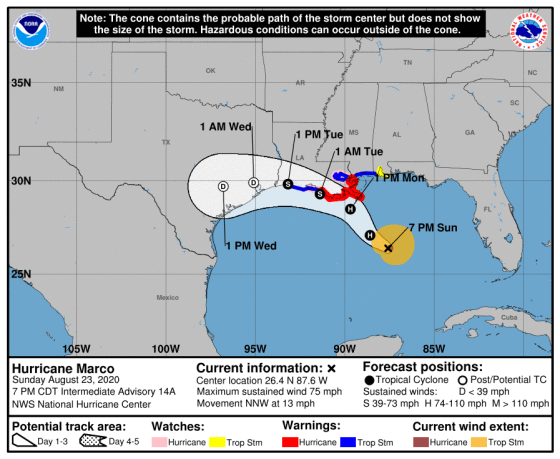
The National Hurricane Center said Marco was about 180 miles (290 kilometers) south-southeast of the mouth of the Mississippi River on Sunday evening and heading north-northwest at 13 mph (20 kph), packing winds of 75 miles per hour (120 kph). The center warned of life-threatening storm surges and hurricane-force winds along the Gulf Coast.

Hurricane Marco Path
National Hurricane CenterThe National Hurricane Center said Marco was about 180 miles south-southeast of the mouth of the Mississippi River on Sunday evening and heading north-northwest at 13 mph.

Haitian civil protection officials said they had received reports that a 10-year-old girl was killed when a tree fell on a home in the southern coastal town of Anse-a-Pitres, on the border with the Dominican Republic. Haiti’s prime minister said at least eight other people died during the storm and two were missing. In the Dominican Republic, relatives told reporters a mother and her young son died after a wall collapsed on them.

Hundreds of thousands were without power in the Dominican Republic as both countries on the island of Hispaniola suffered heavy flooding.

A hurricane watch was issued for the New Orleans metro area, which Hurricane Katrina pummeled in August 2005.

Laura was centered about 30 miles (55 kilometers) west of Cuba’s eastern tip Sunday evening, and its maximum sustained winds were at 60 mph (95 kph). It was moving west-northwest at 21 mph (33 kph).

It was forecast to move over Cuba on Sunday night or Monday.

Tropical Storm Laura
National Hurricane CenterTropical Storm Laura was centered about 30 miles west of Cuba’s eastern tip Sunday evening, and its maximum sustained winds were at 60 mph.

Officials in the Florida Keys, which Laura might pass over on its route into the Gulf, declared a local state of emergency and issued a mandatory evacuation order for anyone living on boats, in mobile homes and in campers. Tourists staying in hotels were warned to be aware of hazardous weather conditions and consider changing their plans starting Sunday.

New warnings were added Sunday morning — including a storm surge warning from Morgan City, Louisiana to Ocean Springs, Mississippi, and a hurricane warning from Morgan City to the mouth of the Pearl River. A tropical storm warning included Lake Pontchartrain in Louisiana, and metropolitan New Orleans.

A storm surge of up to 6 feet (2 meters) was forecast for parts of coastal Louisiana and Mississippi.

Louisiana Gov. John Bel Edwards, who declared a state of emergency Friday, asked President Donald Trump for a federal emergency declaration.

People in Louisiana headed to stores to stock up on food, water and other supplies.

The hurricane center said the storms were not expected to interact as the region faces an unusually active hurricane season.

——

Associated Press writers Freida Frisaro in Miami and Janet McConnaughey in New Orleans contributed to this report.

Tuesday, August 18, 2020

New world news from Time: Mali’s President Resigns After Armed Mutiny by Soldiers


(BAMAKO, Mali) — Mali’s president announced his resignation late Tuesday, just hours after armed soldiers seized him from his home in a dramatic power grab following months of anti-government protests demanding his ouster.

The news of President Ibrahim Boubacar Keita’s departure was met with jubilation by anti-government demonstrators and alarm by former colonial ruler France, and other allies and foreign nations.

Speaking on national broadcaster ORTM just before midnight, a distressed Keita, wearing a mask amid the COVID-19 pandemic, said his resignation — three years before his final term was due to end — was effective immediately. A banner across the bottom of the television screen referred to him as the “outgoing president.”

“I wish no blood to be shed to keep me in power,” Keita said. “I have decided to step down from office.”

He also announced that his government and the National Assembly would be dissolved, certain to further the country’s turmoil amid an eight-year Islamic insurgency and the growing coronavirus pandemic.

Keita, who was democratically elected in 2013 and reelected five years later, was left with few choices after the mutinous soldiers seized weapons from the armory in the garrison town of Kati and then advanced on the capital of Bamako. They took Prime Minister Boubou Cisse into custody along with the president.

There was no immediate comment Wednesday from the troops, who hailed from the same military barracks where a coup was launched more than eight years ago, allowing the Islamic insurgency to take hold amid a power vacuum.

The political upheaval unfolded months after disputed legislative elections. And it also came as support for Keita tumbled amid criticism of his government’s handling of the insurgency, which has engulfed a country once praised as a model of democracy in the region.

The military has taken a beating over the past year from Islamic State and al-Qaida-linked groups. A wave of particularly deadly attacks in the north in 2019 prompted the government to close its most vulnerable outposts as part of a reorganization aimed at stemming the losses.

Tuesday’s developments were condemned by the African Union, the United States, and the regional bloc known as ECOWAS, which had been trying to mediate Mali’s political crisis. Former colonizer France and the United Nations, which has maintained a peacekeeping mission in Mali since 2013, also expressed alarm ahead of Keita’s speech.

U.N. Secretary-General Antonio Guterres sought “the immediate restoration of constitutional order and rule of law,” U.N. spokesman Stephane Dujarric said.

But news of Keita’s detention was met with celebration throughout the capital by anti-government protesters who first took to the streets back in June to demand that the president step down.

“All the Malian people are tired — we have had enough,” one demonstrator said.

The detention was a dramatic change of fortune for Keita, who seven years earlier emerged from a field of more than two dozen candidates to win Mali’s first democratic post-coup election in a landslide with more than 77% of the vote.

Regional mediators from ECOWAS, though, had failed in recent weeks to bridge the impasse between Keita’s government and opposition leaders, creating mounting anxiety about another military-led change of power.

Then on Tuesday, soldiers in Kati took weapons from the armory at the barracks and detained senior military officers. Anti-government protesters immediately cheered the soldiers’ actions, and some set fire to a building that belongs to Mali’s justice minister in the capital.

Cisse urged the soldiers to put down their arms.

“There is no problem whose solution cannot be found through dialogue,” he said in a statement.

But the wheels already were in motion — armed men began detaining people in Bamako too, including the country’s finance minister, Abdoulaye Daffe.

Keita, who tried to meet protesters’ demands through a series of concessions, has enjoyed broad support from France and other Western allies. He also was believed to have widespread backing among high-ranking military officials, underscoring a divide between army leadership and unpredictable rank-and-file soldiers.

Tuesday marked a repeat of the events leading up to the 2012 coup, which unleashed years of chaos in Mali when the ensuing power vacuum allowed Islamic extremists to seize control of northern towns. Ultimately a French-led military operation ousted the jihadists, but they merely regrouped and expanded their reach during Keita’s presidency into central Mali.

Keita’s political downfall closely mirrors that of his predecessor: Amadou Toumani Toure was forced out of the presidency in 2012 after a series of punishing military defeats. That time, the attacks were carried out by ethnic Tuareg separatist rebels. This time, Mali’s military has sometimes seemed powerless to stop extremists linked to al-Qaida and IS.

Back in 2012, the mutiny erupted at the Kati military camp as rank-and-file soldiers began rioting and then broke into the camp’s armory. After grabbing weapons, they later headed for the seat of government under the leadership of Capt. Amadou Haya Sanogo. Sanogo was later forced to hand over power to a civilian transitional government, which then organized the election Keita won.

Mediators this time around have urged Keita to share power in a unity government. He even said he was open to redoing disputed legislative elections. But those overtures were swiftly rejected by opposition leaders who said they would not stop short of Keita’s ouster.

___

Larson reported from Dakar, Senegal. Associated Press Writer Edith M. Lederer at the United Nations contributed to this report.